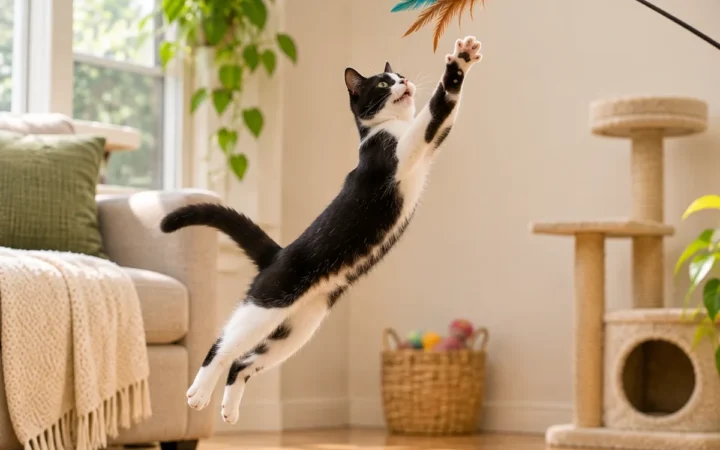

Good enrichment gives indoor cats a chance to do what cats are built to do: hunt, climb, scratch, explore smells and hide. The easiest wins are free: feed part of meals in a homemade food puzzle, rotate a few toys, open up a window view, and play with your cat for 10 to 15 minutes twice a day.
“Enrichment” sounds fancy, but it just means making your home a little more interesting from a cat’s point of view. The AAFP and ISFM environmental needs guidelines describe a few core needs for every cat. Each idea below covers at least one of them.
How we researched this guide
Ideas are based on the AAFP/ISFM Feline Environmental Needs Guidelines, The Ohio State University’s Indoor Pet Initiative, and published research on food puzzles. DIY ideas use common household items. Always supervise new DIY toys at first.
Hunting and food (the biggest win)
1. Toilet-roll food puzzle
Fold the ends of a cardboard tube, poke a few holes slightly bigger than a kibble, and drop food inside. Your cat bats it around to get it out.
2. Egg-carton forage tray
Put a few kibbles in each cup of a cardboard egg carton. Beginners get it open; for experts, close the lid.
3. Muffin tin and balls
Put kibble in a muffin tin and cover some cups with ping-pong balls. Cats learn to flip the balls out.
4. Box with holes
Cut paw-sized holes in a shoebox, tape the lid on and drop treats inside. Cats fish them out.
5. Kibble scatter hunt
Instead of a bowl, toss small amounts of dry food across the floor or a rug, one piece at a time, for your cat to chase.
6. Several small meals
Cats naturally eat many small meals. Splitting daily food into 4 or more portions, some in puzzles, keeps them busy. Ready-made options are in our slow feeder guide.

Play
7. Two short “hunts” a day
Ten to fifteen minutes with a wand toy, moving it like prey, ending with a catch and a meal. Nothing on this list matters more.
8. Toy rotation box
Keep toys in a closed box and put out three or four at a time, swapping every few days.
9. Paper ball and paper bag
A scrunched-up paper ball is a classic for a reason. A paper bag (handles removed) is a tent, a tunnel and a hiding spot.
10. Ping-pong ball in the bathtub
A dry bathtub makes a perfect arena: the ball can’t escape and cats love the noise.
11. Clicker training
Cats can learn to sit, high-five, come when called or go into a carrier. Five-minute sessions with treats are great mental exercise.
Climbing and resting up high
12. Clear a shelf
Cats feel safer when they can watch from above. Clear the top of a bookcase or a sturdy shelf near a window.
13. Build a route
Arrange a chair, a cat tree and a shelf so your cat can travel around a room without touching the floor. See cat trees for small spaces for compact options.
14. Window seat
A perch or even a cushion on a deep sill turns the window into all-day TV. Big cat? See window perches for large cats.
Scratching
15. Cardboard scratchers in key spots
Flat cardboard scratchers are cheap. Put them near sleeping spots and room entrances, where cats like to scratch after waking up and to mark territory.
16. One tall, heavy post
Cats need to stretch fully while scratching. A post should be taller than your cat stretched out and shouldn’t wobble. See scratching posts for large cats.
Senses: smell, sight and sound
17. Sniff box
Fill a box with crumpled paper and a sprinkle of catnip or silvervine, or a sock that smells of another pet or a visitor. Smell is a huge part of a cat’s world.
18. Cat-safe grass
A pot of cat grass (usually wheat or oat grass) gives cats something safe to chew. Many common houseplants, including all true lilies, are toxic to cats, so check the ASPCA’s toxic plant list before bringing plants home.
19. Bird feeder view
If you can, put a bird feeder where your cat can watch it from inside.
20. Bring the outside in
Leaves, a pine cone or a clean stick from outside (pesticide-free) give your cat new smells to investigate. Remove them after a day.
21. Cat TV
Bird and squirrel videos for cats are a fun extra for some cats. Put the screen low and stable.
Safe spaces and routine
22. A box in every room
Cardboard boxes reduce stress and give cats a place to hide and ambush. A study of shelter cats found that cats given a hiding box adapted to their new environment faster.
23. Warm, quiet nap spots
A blanket in a sunny spot, or a covered bed away from foot traffic.
24. Predictable schedule
Meals and play at roughly the same times every day help cats feel secure.
25. Supervised outdoor time (optional)
A secure balcony enclosure (“catio”), a harness walk for confident cats, or an open screened window with a cat-proof screen. Go slowly and safely. See how to keep a cat from escaping first.
Start small. Pick three ideas this week: one food puzzle, one change to play, and one new spot to climb or look out from. Watch what your cat enjoys and build from there.
Safety first: supervise new DIY toys, remove anything with string or small parts your cat could swallow, and keep total food (including puzzle food and treats) within your cat’s daily allowance. Sudden changes in behavior can be a sign of pain or illness, so check with your vet if your cat seems “bored” in a new way. This guide is general information, not veterinary advice.
FAQ
What is environmental enrichment for cats?
Changes to a cat’s surroundings and routine that let them perform natural behaviors like hunting, climbing, scratching and exploring, which supports their physical and mental health.
How do I know if my indoor cat is bored?
Common signs include destructive scratching, knocking things over, night-time activity, overgrooming, overeating, attention-seeking crying and ambushing ankles.
What’s the cheapest way to enrich an indoor cat?
Daily wand play, cardboard boxes, homemade food puzzles and a clear window view. All cost nothing or close to it.
Are puzzle feeders good for all cats?
Most cats can use them if you start easy. Make the first puzzles very simple so your cat succeeds, and make sure they still eat their full daily amount.
Sources
- Ellis SLH, Rodan I, et al. AAFP and ISFM Feline Environmental Needs Guidelines. Journal of Feline Medicine and Surgery (2013).
- Dantas LMS, Delgado MM, Johnson I, Buffington CAT. Food puzzles for cats: feeding for physical and emotional wellbeing. Journal of Feline Medicine and Surgery (2016).
- Vinke CM, Godijn LM, van der Leij WJR. Will a hiding box provide stress reduction for shelter cats? Applied Animal Behaviour Science (2014).
- ASPCA Animal Poison Control Center, toxic and non-toxic plants list.
- The Ohio State University College of Veterinary Medicine, Indoor Pet Initiative.

PurrScout Editorial Team
We research cat products and care topics using manufacturer documentation, veterinary guidance and thousands of real owner reviews. We never claim hands-on testing we didn't do. How we research.