Most cats sleep a large part of the day, so you don’t need to entertain them for eight hours. Aim for three things: something to watch (a window perch), something to work for (a food puzzle or hidden treats), and something new to explore (toys rotated every few days). Then do 10 to 15 minutes of real play when you get home, followed by a meal. That routine does more than any gadget.
Leaving a cat alone all day can feel guilty, especially if you come home to a cat who yowls at you or knocks things off the counter. The good news is that cats are built for short bursts of activity followed by long rests. You don’t have to fill every hour. You just have to give their hunting instincts somewhere to go.
How we researched this guide
This guide draws on feline environmental needs guidance from the AAFP and ISFM, the Indoor Pet Initiative from The Ohio State University College of Veterinary Medicine, and research on food puzzles for cats. Product mentions are based on specs and owner reviews, not our own testing.
First: what does a bored indoor cat look like?
Boredom in cats often looks like “bad behavior”: knocking things over, scratching furniture, night-time zoomies, overgrooming, overeating, attacking ankles, or crying at you as soon as you walk in. If you see several of these, more enrichment is usually part of the answer. If any appear suddenly, rule out a medical cause with your vet first.
Before you leave: set up the day
1. Give them a window seat
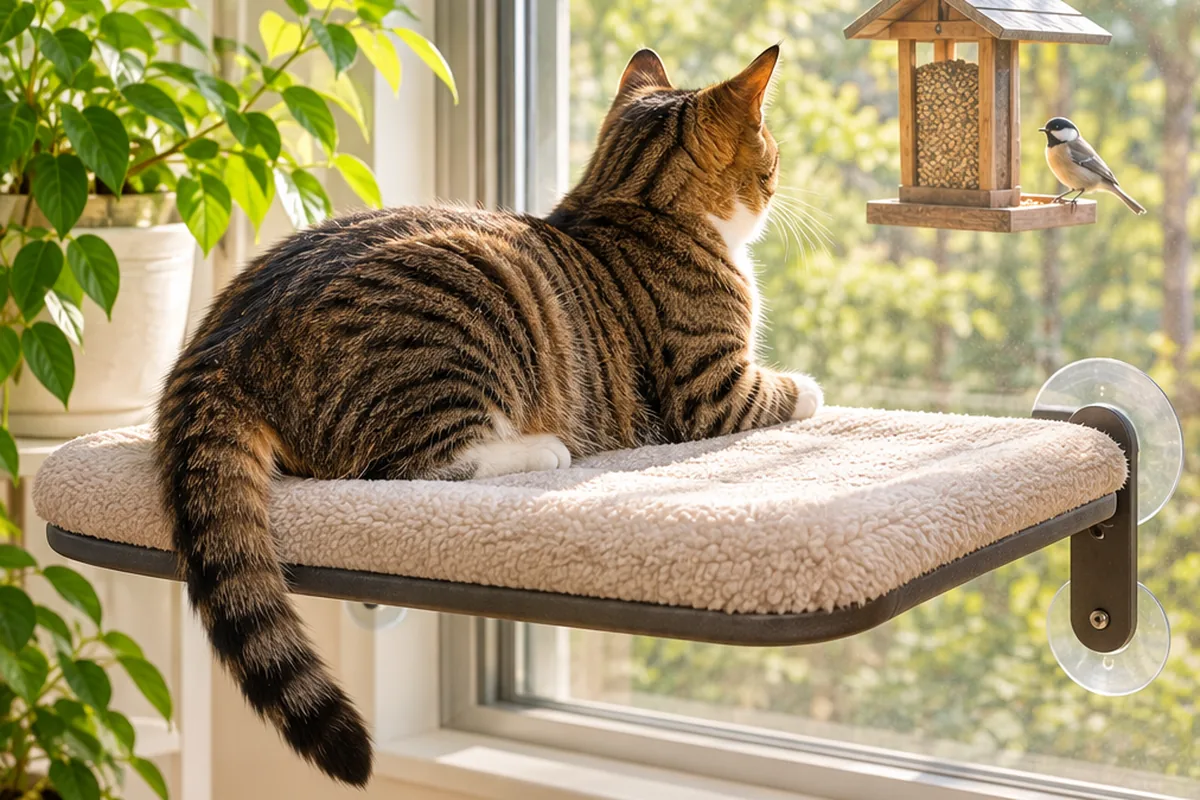
Watching birds, people and cars is free entertainment for hours. A sturdy window perch puts your cat right at the glass. If you have a big cat, see our picks for the best window perches for large cats. For extra action, place a bird feeder outside a window you can see from the perch (where it’s safe and allowed).
2. Turn breakfast into a hunt
In the wild, cats work for every meal. Food puzzles, treat balls and slow feeders let indoor cats do the same. Research on food puzzles has linked them with more activity and calmer behavior in many cats. Put part of the day’s dry food in a puzzle feeder before you leave. Start easy so your cat succeeds. Our guide to slow feeders for cats covers options for both dry and wet food.
3. Hide a few treats or kibble
Put small portions of food in different spots: on a cat tree shelf, inside a paper bag, under a cardboard box with a hole cut in it. Keep the total within your cat’s daily food allowance.
4. Rotate toys, don’t add toys
Cats lose interest in toys they see every day. Keep most toys in a closed box and put out three or four at a time. Swap them every few days. Old toys feel new again.
5. Leave safe solo toys only
Kicker toys, balls in tracks, crinkle tunnels and catnip toys are good for alone time. Put away anything with strings, ribbons, elastic or feathers on wands before you leave, because swallowed string can cause serious intestinal injuries.
6. Something to climb and something to scratch
Height lets cats survey their territory and feel safe. A cat tree or wall shelves near a window doubles as a lookout. A tall, sturdy scratching post gives them a place to stretch and mark. See our guides to cat trees for small spaces and scratching posts.
7. Hiding spots and boxes
Cardboard boxes, paper bags (handles removed) and covered beds give cats safe places to nap and ambush. They cost nothing and many cats prefer them to expensive toys.
8. Consider an automatic toy, carefully
Battery-powered toys with random movement can fill some of the day. Choose ones with an automatic shut-off and timed sessions, check them for loose parts, and don’t rely on them alone. Some cats love them, others ignore them. Laser toys can frustrate some cats because there’s nothing to catch, so finish laser sessions with a real toy or treat. Our interactive toy guide compares the popular ones.
9. Cat TV, as a bonus
Some cats enjoy bird and squirrel videos made for cats. It’s harmless for most cats and fine as a background extra, but it’s not a substitute for real play.
When you get home: the routine that matters most
10. Play like prey, for 10 to 15 minutes
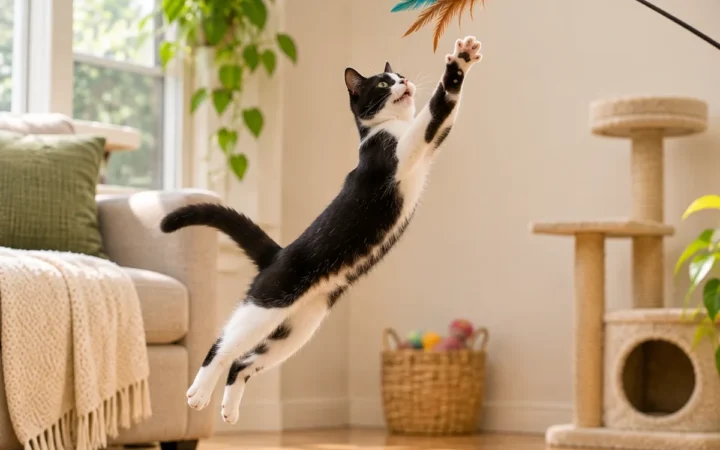
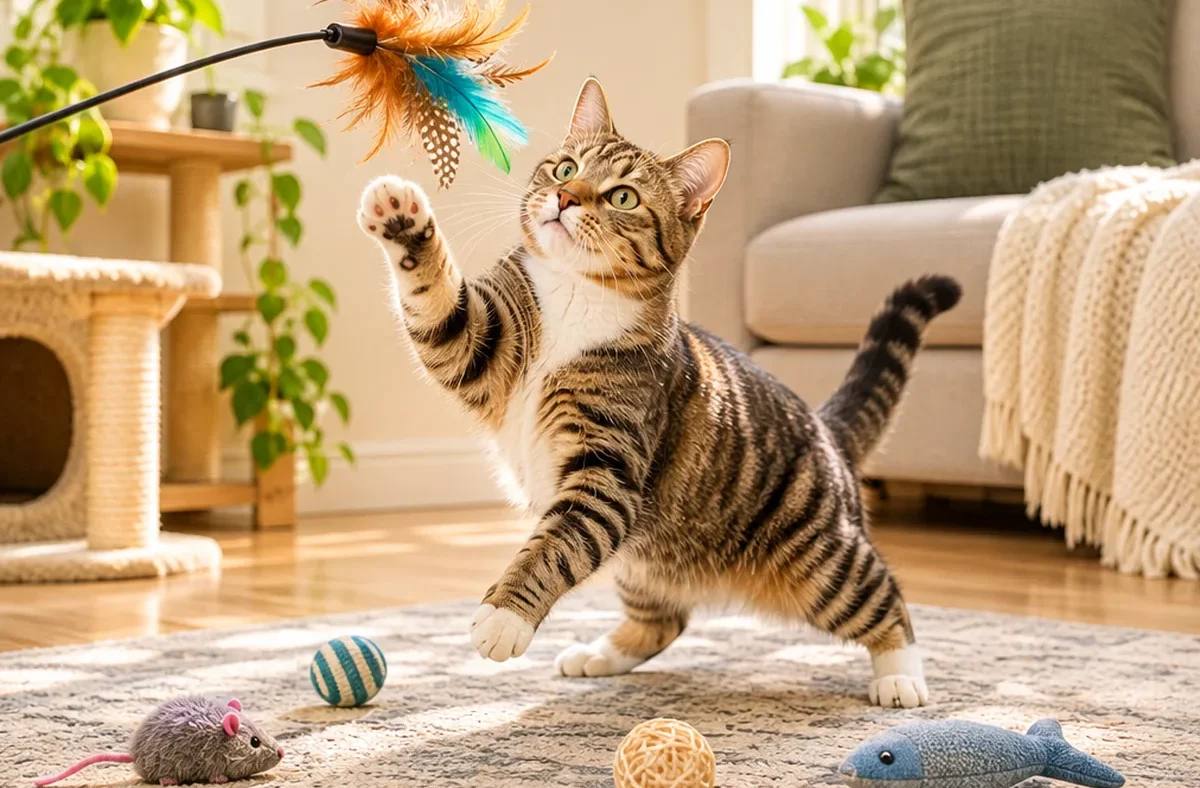
Use a wand toy and move it like a mouse or bird: hide it behind furniture, let it stop and twitch, make it run away. Let your cat stalk, chase and pounce. Two short sessions a day work well for most adult cats; kittens and young cats often need more.
11. End with a “catch,” then a meal
Let your cat catch the toy at the end, then feed a meal or a few treats. Hunt, catch, eat, groom, sleep is the natural sequence, and it’s often what calms a cat who is wild in the evening or at night.
12. Keep a routine
Cats like predictability. Play and feed at roughly the same times each day. It often reduces early-morning wake-up calls too.
Would a second cat help? Sometimes. A well-matched pair of young cats can keep each other busy. But many adult cats prefer being the only cat, and a poor match can cause stress. If you’re considering it, talk to your vet or a shelter about temperament first.
A sample workday plan
- Morning (5 minutes): short play session, then breakfast in a food puzzle. Set out 3 or 4 rotated toys and hide a few kibbles.
- Daytime: window perch, cat tree, boxes, solo toys. Curtains open.
- Evening (15 minutes): wand toy play, ending in a catch, then dinner.
- Before bed (5 minutes): a final short play session and a small snack can help night-active cats settle.
When to talk to your vet: sudden changes in behavior, like hiding, aggression, overgrooming to the point of bald spots, crying at night in an older cat, or changes in appetite, can be signs of pain or illness rather than boredom. This guide is general information, not veterinary advice.
FAQ
Is it cruel to leave a cat alone while I work?
No. Most healthy adult cats cope well with a normal workday alone, as long as they have food, water, a clean litter box and things to do, plus attention and play when you’re home.
How long can an indoor cat be left alone?
A typical workday is fine for most adult cats. For longer trips, arrange for someone to check on your cat at least once a day.
Should I leave the TV or radio on for my cat?
It doesn’t hurt, and some cats seem to like background noise. It won’t replace play, though.
Why is my cat so crazy when I get home?
Your cat has been resting all day and is ready for action. That’s normal. Use it: play first, then feed.
Sources
- Ellis SLH, Rodan I, et al. AAFP and ISFM Feline Environmental Needs Guidelines. Journal of Feline Medicine and Surgery (2013).
- Dantas LMS, Delgado MM, Johnson I, Buffington CAT. Food puzzles for cats: feeding for physical and emotional wellbeing. Journal of Feline Medicine and Surgery (2016).
- The Ohio State University College of Veterinary Medicine, Indoor Pet Initiative.

PurrScout Editorial Team
We research cat products and care topics using manufacturer documentation, veterinary guidance and thousands of real owner reviews. We never claim hands-on testing we didn't do. How we research.