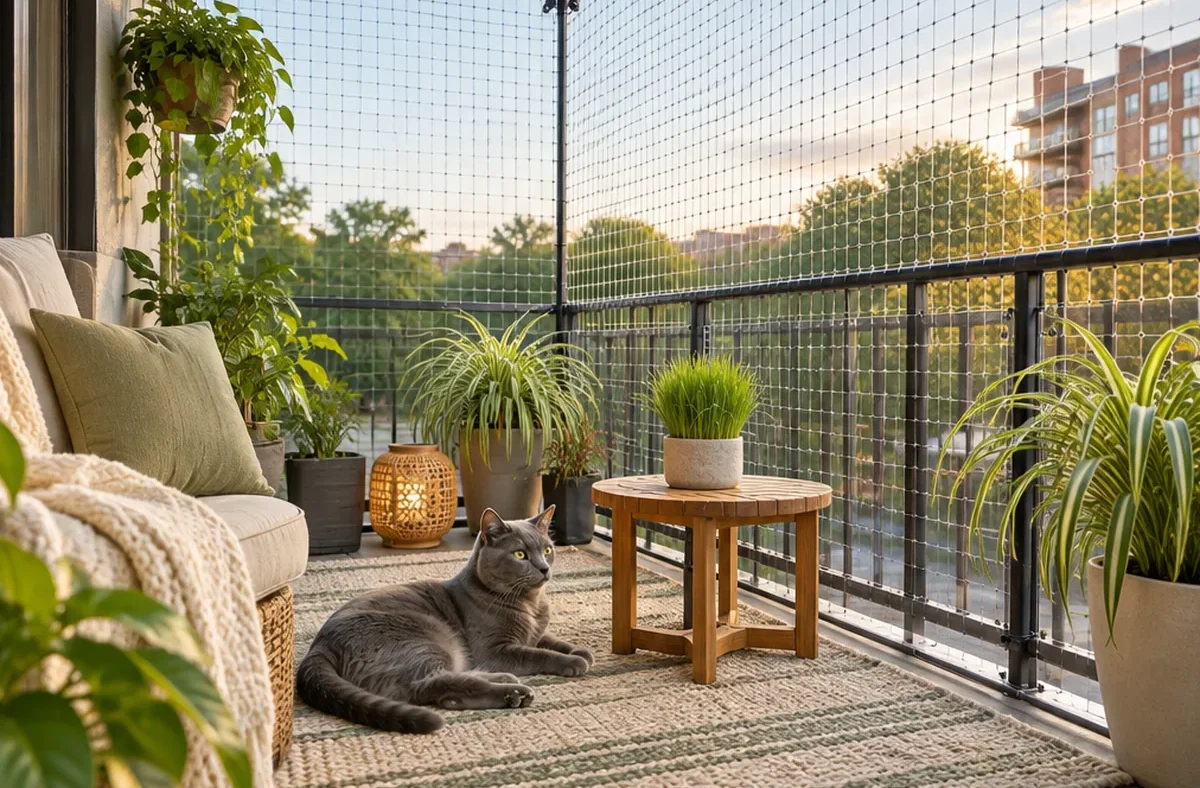
An open balcony is never fully safe for a cat, even a calm one. The only reliable fix is to enclose it: cat netting on the open sides and top, plus mesh or panels over gaps in the railing. Renters can use tension-rod or freestanding frames that don’t need drilling. Remove toxic plants, keep climbable furniture away from the edge, and supervise until you’re sure the setup has no gaps.
Cats are great climbers and usually land on their feet, so it’s easy to assume a balcony is fine. It isn’t. Cats get distracted by birds and insects, misjudge a jump onto a narrow railing, or slip while sleeping on a ledge. Vets see falls from balconies and windows so often that the injuries have a name: high-rise syndrome.
How we researched this guide
This guide draws on veterinary studies of cats injured in falls from height, ASPCA information on toxic plants, and feline environmental needs guidance. We describe types of products and setups rather than testing specific products ourselves. Always check your building’s rules and your lease before installing anything.
Why balconies are risky for cats
- Falls happen from every height. In veterinary studies of cats treated after falls, most fell from apartment windows and balconies, often only a few floors up. Many survived with treatment, but injuries to the chest, jaw, teeth and legs were common.
- Railings have gaps. If a cat can fit its head through a gap, it can usually fit its body. Many standard railings are wide enough for a cat, and especially a kitten, to squeeze through.
- Prey drive beats caution. A bird or moth flying past can make even an older, careful cat leap without thinking.
- The ledge looks like a perch. Cats love high, narrow places to watch the world. A railing top is exactly that, with nothing on one side.
How to make a balcony safe for cats: step by step
1. Check your lease and building rules
Many buildings limit what you can attach to railings or walls. Ask your landlord or HOA first. Clear or black netting is usually less noticeable from outside and more likely to be approved.
2. Enclose the open sides (and the top if needed)
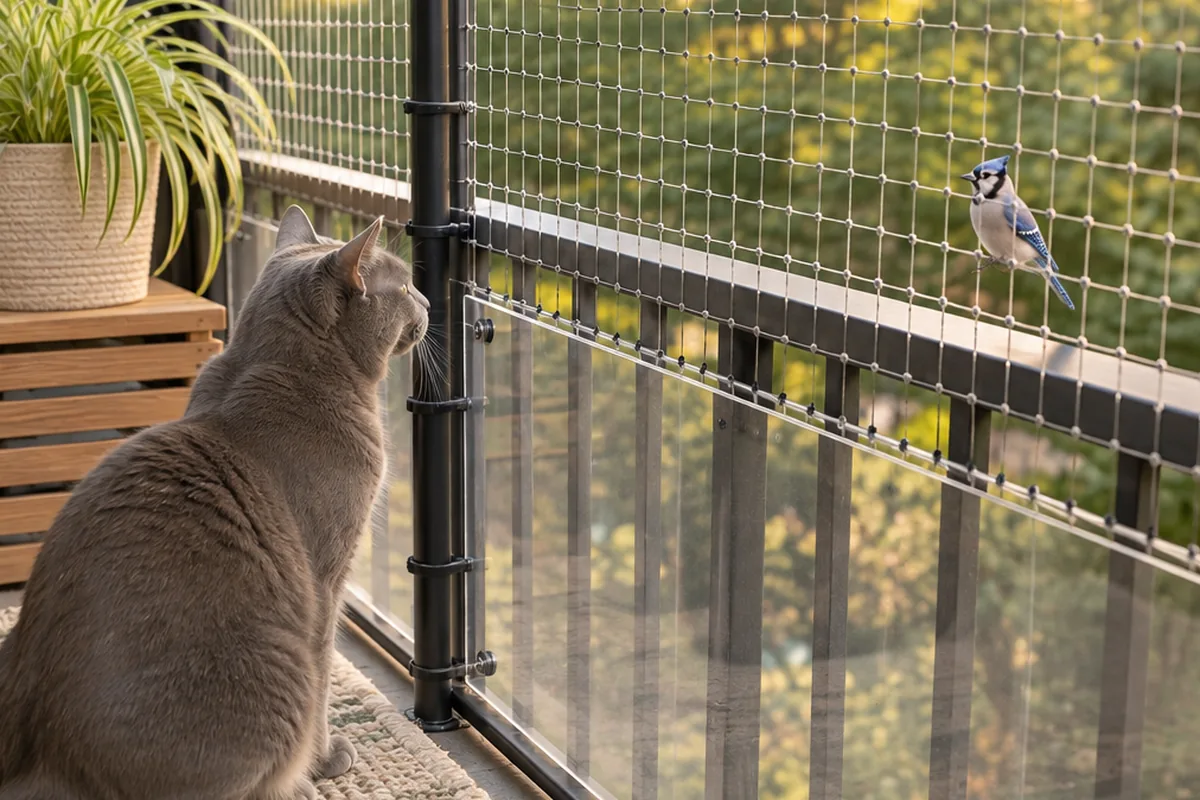
Cat netting is the most common solution: a strong polyethylene or nylon mesh attached to a frame, wall hooks or the balcony ceiling. Choose netting sold specifically for cats, with small openings and UV resistance, and pull it tight so there are no loose areas to climb. If your balcony has no roof, or your cat is a strong climber, cover the top too.
3. Close gaps in the railing
Even with netting above, cover the lower railing with plexiglass panels, mesh or a balcony privacy screen secured with zip ties. Pay attention to the gap at the floor, where many cats and kittens slip under.
4. Renter-friendly, no-drill options
- Tension-rod systems: poles that press between the floor and the balcony ceiling, with netting attached. No drilling, easy to remove when you move out.
- Freestanding cat enclosures (mini catios): mesh tents or wooden frames that sit on the balcony floor. Your cat gets fresh air inside the enclosure, even if the balcony itself stays open.
- Window catio boxes: small enclosures that fit a window, for homes where the balcony can’t be secured.
5. Move climbable things away from the edge
Chairs, tables, plant stands and storage boxes near the railing act as steps. Keep furniture in the middle of the balcony, and give your cat a safe high spot inside the enclosed area instead.
6. Remove toxic plants
Many popular balcony plants are poisonous to cats. All true lilies (Lilium and Hemerocallis) are extremely dangerous: even a small amount of pollen or water from the vase can cause kidney failure. Check every plant against the ASPCA’s toxic and non-toxic plant lists. Cat grass, catnip and spider plants are popular cat-safe options.
7. Watch for heat, cold and chemicals
Dark tiles and metal can get hot in summer sun, so give your cat a shaded area and fresh water. Keep grill tools, lighter fluid, pest sprays, fertilizers and de-icing salt stored away.
8. Supervise at first, then check regularly
Stay with your cat for the first few sessions and watch where they test the netting or squeeze. Check ties, hooks and netting every few weeks, especially after storms or strong wind.
Can’t enclose the balcony? Keep the balcony door closed and bring the outdoors in: a sturdy window perch, a bird feeder visible from inside, and pet-resistant window screens give your cat a view without the risk.
What about a harness and leash?
A well-fitted harness can be a good way to let a trained cat enjoy an open balcony, but only with you holding the leash or close by. Never tie a cat on a balcony: they can tangle, panic or jump over the edge and get hurt. Introduce the harness indoors first, with treats, over several days.
Signs your cat may try to get out
- Staring at birds and chattering, then crouching
- Jumping onto furniture near the railing
- Pushing their head into gaps or pulling at the netting
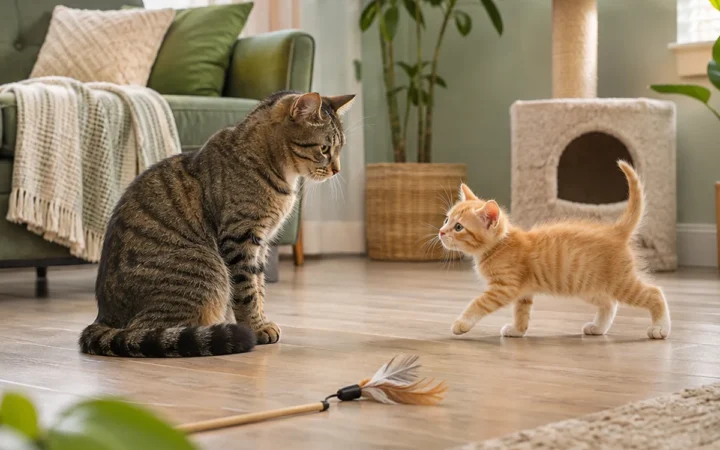
- Kittens and young cats, who are more impulsive
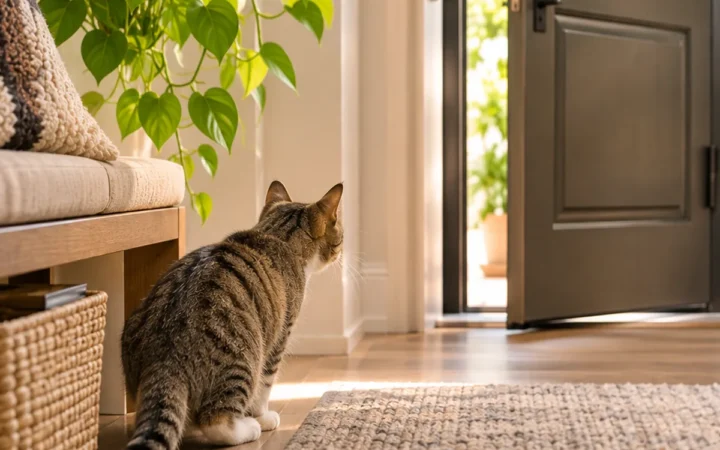
For door-dashers and escape artists, see our guide on how to keep a cat from escaping.
If your cat falls, take them to a vet right away, even if they seem fine. Chest injuries and internal bleeding aren’t always visible at first. Check that your cat is microchipped and the contact details are current. This guide is general information, not veterinary advice.
FAQ
Is it safe to let my cat on the balcony?
Only if the balcony is fully enclosed, or your cat is on a harness with you right there. An open balcony carries a real risk of falls, even for calm cats.
Do cats know not to jump off balconies?
Not reliably. Cats can be startled, chase a bird, or slip from a narrow ledge. Their good balance doesn’t protect them from distraction.
Can a cat survive a fall from a balcony?
Many do with veterinary treatment, but injuries are common, including broken jaws, teeth and legs, and chest trauma. Prevention is far better than treatment.
How can I cat-proof a balcony without drilling?
Use tension-rod poles with cat netting, a freestanding mesh enclosure, or railing covers secured with zip ties. Check your lease before installing anything.
What is the best netting for a cat balcony?
Look for netting made for cats, with small openings, UV resistance and a strong weave (often polyethylene or nylon). Clear or black netting is the least noticeable.
Sources
- Whitney WO, Mehlhaff CJ. High-rise syndrome in cats. Journal of the American Veterinary Medical Association (1987).
- Vnuk D, Pirkić B, Matičić D, et al. Feline high-rise syndrome: 119 cases (1998-2001). Journal of Feline Medicine and Surgery (2004).
- ASPCA Animal Poison Control Center, toxic and non-toxic plants list (cats).
- Ellis SLH, Rodan I, Carney HC, et al. AAFP and ISFM Feline Environmental Needs Guidelines. Journal of Feline Medicine and Surgery (2013).

PurrScout Editorial Team
We research cat products and care topics using manufacturer documentation, veterinary guidance and thousands of real owner reviews. We never claim hands-on testing we didn't do. How we research.